
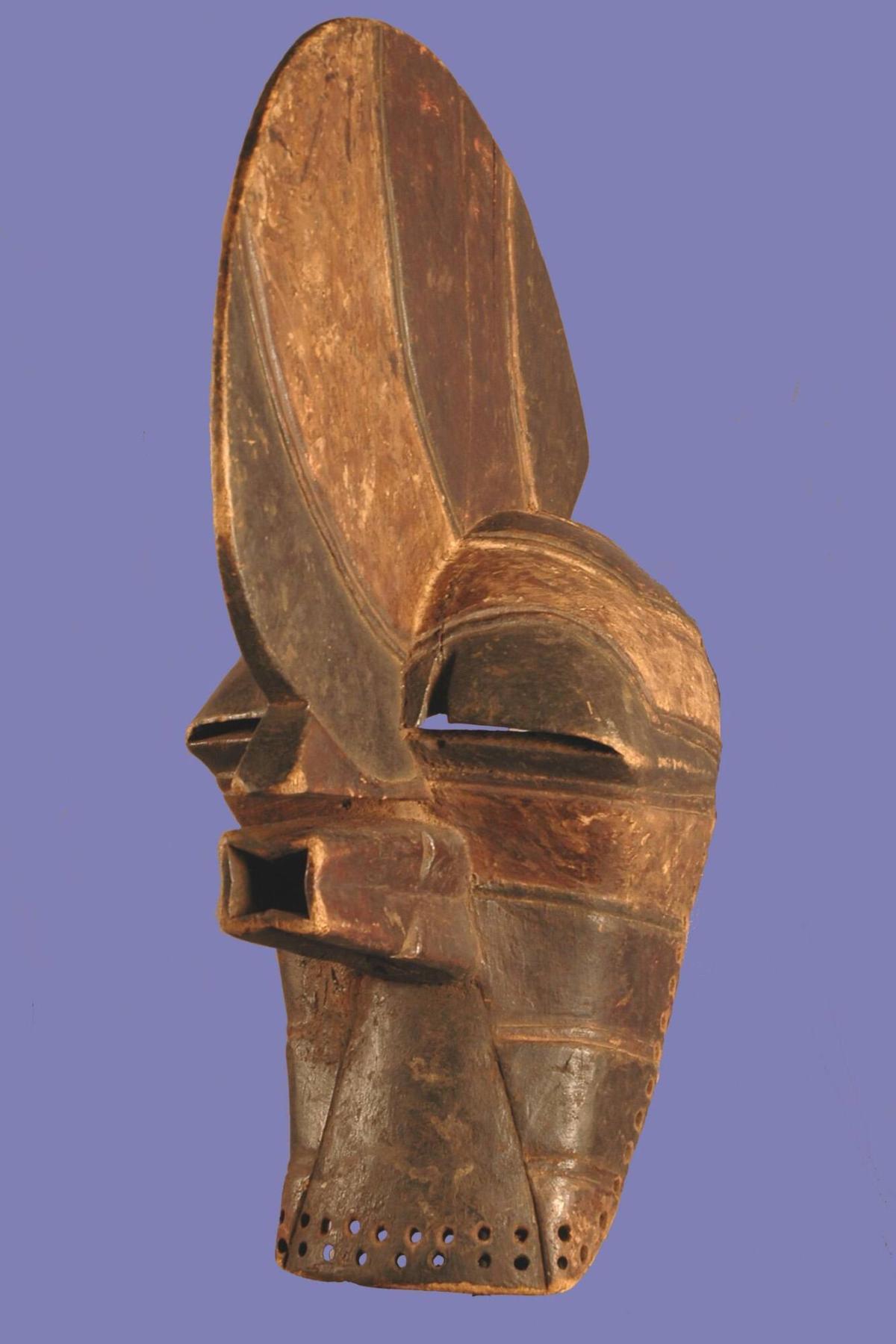
Kifwebe Mask
Artist/Maker
Songye peoples
, Democratic Republic of the Congo
Date20th century
MediumWood and kaolin
DimensionsOverall: 23 × 9 × 16 1/4 in. (58.4 × 22.9 × 41.3 cm)
Mount: 14 1/2 × 8 1/2 × 7 1/4 in. (36.8 × 21.6 × 18.4 cm)
Mount: 14 1/2 × 8 1/2 × 7 1/4 in. (36.8 × 21.6 × 18.4 cm)
Credit LineGift in honor of Alexandra Gould (OC 2011)
Object number2011.26.40
Status
Not on viewAmong the Songye people of the Democratic Republic of the Congo, the most powerful masking society is the Bwada Ka Bifwebe, which utilizes the masks commonly referred to as Kifwebe masks.
The Kifwebe masking society maintains social order on Songye culture by reinforcing positive male values among initiates, and by performing publicly and maintaining order on the village level. Kifwebe masks are best known for their striated surfaces; often colored in red, white and black. The primary colors refer to life, death, and transformation; day, night, and sunset.
The masks of the society may be generally broken down into three basic forms: the female mask, which is generally mostly white with a finely striated surface and rounded head without a crest; the young male mask with striations in bold colors with a low sagittal crest, and the elder mask, which has a high sagittal crest and generally wider striations than either of the other two masks.
The female mask is associated with the moon and beauty, mystery and divination, while the youth and elder masks are associated with maintaining order.
This mask is a classical elder’s mask; with a high crest and vibrant alternating bands of red and white. The mask would have been part of a fully netted costume and also would have included a long beard laced into the double set of perforations at the bottom of the mask.
This mask would have performed in public dances, but would also have had a very strong role in secret meetings. These meetings would have taken place in the Kyobo, or sacred Kifwebe hut, where the organization kept its paraphernalia and where initiates would eventually come to learn about the masks and masking and its role in Songye society.
ProvenancePatrick Derick, Brussells, Belgium; acquired by Mohammed Kaba; acquired by Peter G. Gould and Robin M. Potter, Haddonfield, NJ; by gift 2011 to Allen Memorial Art Museum, Oberlin, OHThe Kifwebe masking society maintains social order on Songye culture by reinforcing positive male values among initiates, and by performing publicly and maintaining order on the village level. Kifwebe masks are best known for their striated surfaces; often colored in red, white and black. The primary colors refer to life, death, and transformation; day, night, and sunset.
The masks of the society may be generally broken down into three basic forms: the female mask, which is generally mostly white with a finely striated surface and rounded head without a crest; the young male mask with striations in bold colors with a low sagittal crest, and the elder mask, which has a high sagittal crest and generally wider striations than either of the other two masks.
The female mask is associated with the moon and beauty, mystery and divination, while the youth and elder masks are associated with maintaining order.
This mask is a classical elder’s mask; with a high crest and vibrant alternating bands of red and white. The mask would have been part of a fully netted costume and also would have included a long beard laced into the double set of perforations at the bottom of the mask.
This mask would have performed in public dances, but would also have had a very strong role in secret meetings. These meetings would have taken place in the Kyobo, or sacred Kifwebe hut, where the organization kept its paraphernalia and where initiates would eventually come to learn about the masks and masking and its role in Songye society.
Collections
- African & Oceanic
The AMAM continually researches its collection and updates its records with new findings.
We welcome additional information and suggestions for improvement. Please email us at AMAMcurator@oberlin.edu.
We welcome additional information and suggestions for improvement. Please email us at AMAMcurator@oberlin.edu.
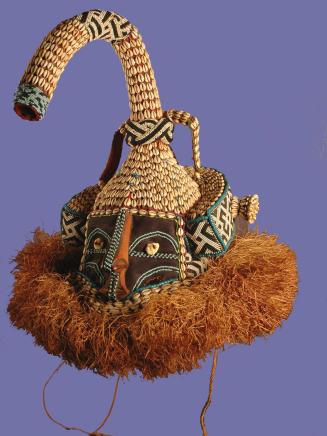
20th century
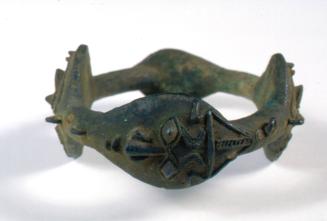
18th–19th century
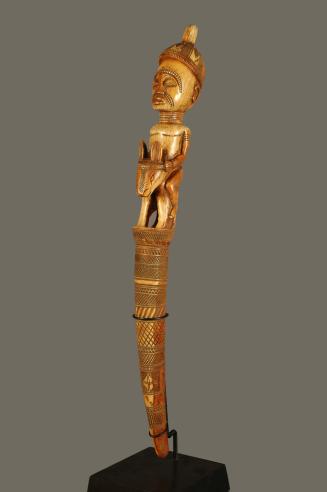
n.d.
20th century
19th century
20th century
20th century
20th century
20th century
late 19th–early 20th century