
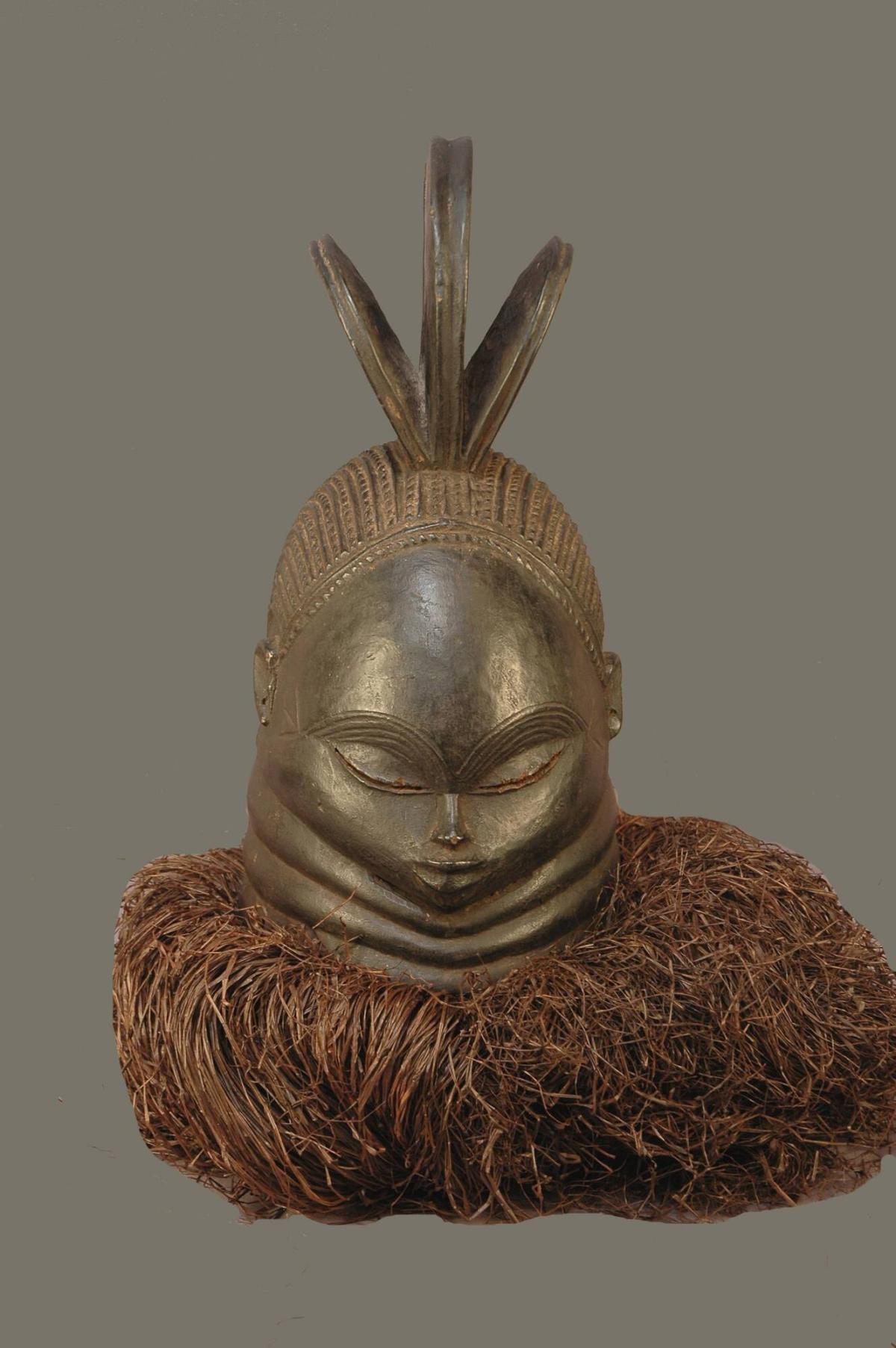
Sande Society Mask (Sowei)
Artist/Maker
Mende peoples
, Sierra Leone
Date20th century
MediumWood and raffia
DimensionsOverall: 16 1/2 × 8 × 9 in. (41.9 × 20.3 × 22.9 cm)
Credit LineGift in honor of Alexandra Gould (OC 2011)
Object number2011.26.35
Status
Not on viewSowei masks of the Mende (often referred to as Bundu masks) appear to be the only masks in Africa danced exclusively by women for a women’s initiatory society, called Sande. The initiatory society was an age/grade society that oversaw the young women in their transition from girlhood to womanhood.
Though carved by men, Sowei masks of the Sande society are commissioned by high-ranking women who will wear them in public at various times throughout the initiations of the girls. Highly uniform in some senses, Sowei masks also display a dizzying variety of iconographic attributes in rendering the coiffure and related decoration. These masks are said to represent an idealized image of Womanhood.
This fine example is augmented by the crested coiffure balanced atop the head. It is unclear if this is an actual coif, or a reference to the female genitals, particularly the labia. In its original context, this mask would have been attached to a large fiber costume and made its most dramatic appearances upon the release of the girls from the bush school, much like Poro masks among boys’ initiations in Liberia.
The blackened surface would have been polished to shine and then oiled – often stove-black was used to make the masks deep black in color. The shiny surfaces referred to the oiled skins of young women, a sign of beauty and youth.
ProvenanceKhalifa Diabate; by gift to Peter G. Gould and Robin M. Potter, Haddonfield, NJ; by gift 2011 to Allen Memorial Art Museum, Oberlin, OHExhibition History
Though carved by men, Sowei masks of the Sande society are commissioned by high-ranking women who will wear them in public at various times throughout the initiations of the girls. Highly uniform in some senses, Sowei masks also display a dizzying variety of iconographic attributes in rendering the coiffure and related decoration. These masks are said to represent an idealized image of Womanhood.
This fine example is augmented by the crested coiffure balanced atop the head. It is unclear if this is an actual coif, or a reference to the female genitals, particularly the labia. In its original context, this mask would have been attached to a large fiber costume and made its most dramatic appearances upon the release of the girls from the bush school, much like Poro masks among boys’ initiations in Liberia.
The blackened surface would have been polished to shine and then oiled – often stove-black was used to make the masks deep black in color. The shiny surfaces referred to the oiled skins of young women, a sign of beauty and youth.
Wildfire Test Pit
- Allen Memorial Art Museum, Oberlin, OH (August 30, 2016 - June 12, 2016 )
Collections
- African & Oceanic
The AMAM continually researches its collection and updates its records with new findings.
We welcome additional information and suggestions for improvement. Please email us at AMAMcurator@oberlin.edu.
We welcome additional information and suggestions for improvement. Please email us at AMAMcurator@oberlin.edu.
20th century
18th–19th century
n.d.
20th century
19th century
20th century
20th century
20th century
20th century
late 19th–early 20th century