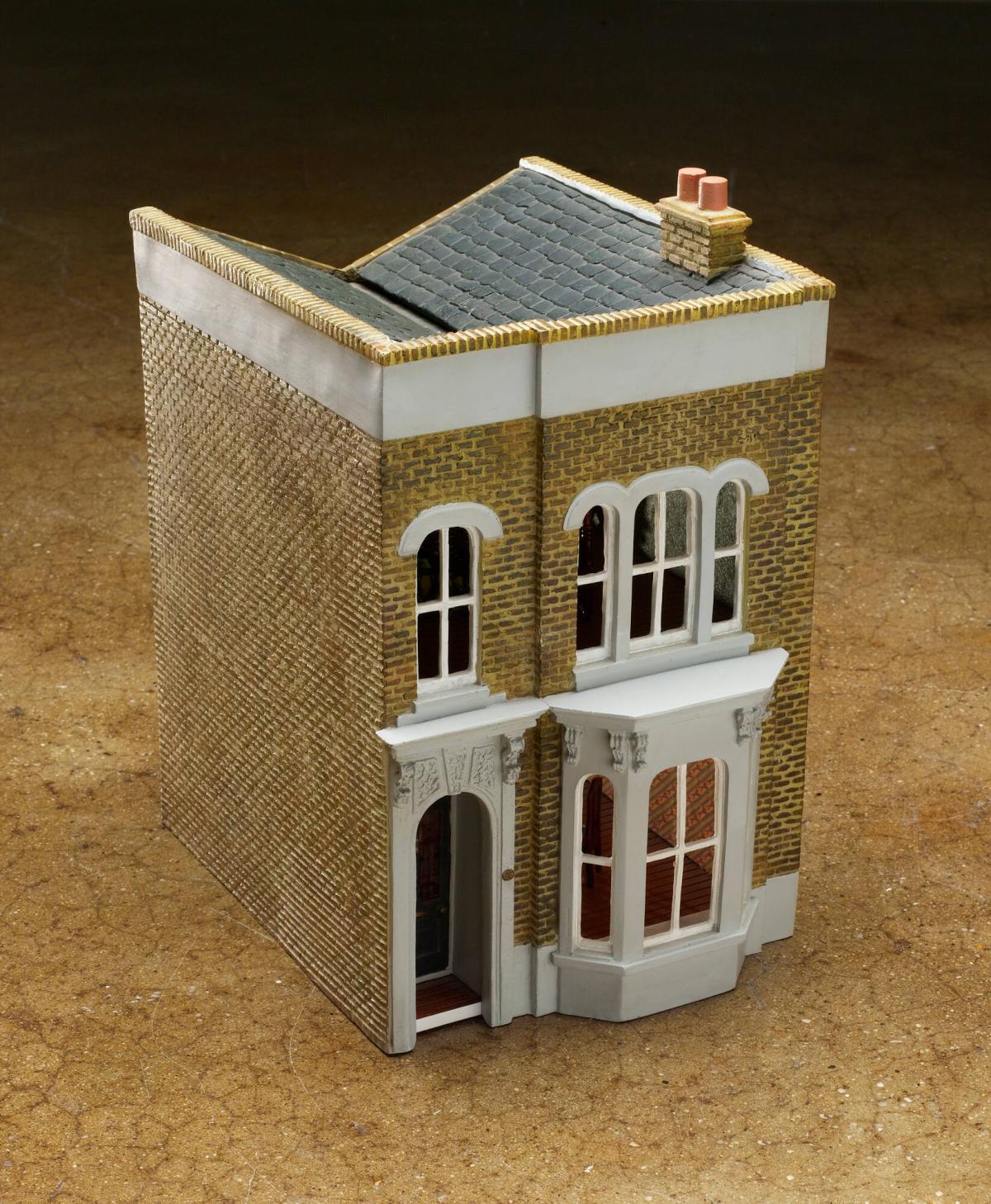
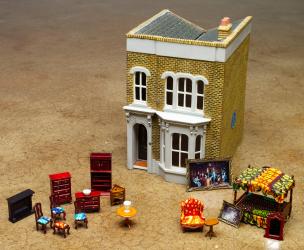
Doll House, for the Peter Norton Family Christmas Project
Artist/Maker
Yinka Shonibare
(English, b. 1962)
Date2002
MediumPainted composite resin, plastic, beech wood, paper, fabric, and porcelain.
DimensionsOverall: 12 3/4 × 8 × 10 5/8 in. (32.4 × 20.3 × 27 cm)
Credit LineGift of Anne and Joel Ehrenkranz
PortfolioPeter Norton Family Christmas Project
Object number2011.28.9A-V
Status
Not on viewBorn in London, but raised primarily in Lagos, Nigeria, Yinka Shonibare often refers to himself as a “post-colonial hybrid.” As both British and Yorùbá, Shonibare focuses on duality and examinations of race, representation, identity, and the complicated relationship that exists between Europe and Africa in the wake of colonialism.
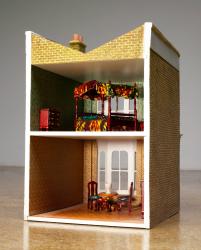
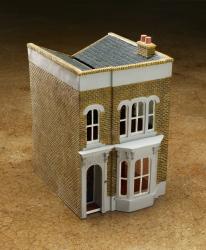
In Dollhouse, the artist playfully subverts the Victorian tradition of producing custom-made dollhouses for wealthy families as miniatures of their lavish homes. Here the artist has replicated his own Victorian town house in London. As in other projects, Shonibare has chosen to “Africanize” an English subject as a critique of imperialism. The furnishings show significant use of batik fabric. Ironically, even as such fabric has strong African associations, its origins are actually Indonesian. Popular in West Africa since its introduction during colonialism, batik fabric is typically exported to the continent from British and Dutch manufacturers. Dollhouse also includes framed miniatures of a painting by French Rococo artist Jean-Honoré Fragonard and of one of Shonibare’s own photographic works, which portrays the artist as a dandy in a Victorian home library. Both emphasize the fusion of Eurocentric and Afrocentric influences within this work. Yet Shonibare’s sequestering of Afrocentric elements to the interior emphasizes that “African-ness” must often remain hidden in the private sphere, behind the facade of English identity.
Exhibition History
In Dollhouse, the artist playfully subverts the Victorian tradition of producing custom-made dollhouses for wealthy families as miniatures of their lavish homes. Here the artist has replicated his own Victorian town house in London. As in other projects, Shonibare has chosen to “Africanize” an English subject as a critique of imperialism. The furnishings show significant use of batik fabric. Ironically, even as such fabric has strong African associations, its origins are actually Indonesian. Popular in West Africa since its introduction during colonialism, batik fabric is typically exported to the continent from British and Dutch manufacturers. Dollhouse also includes framed miniatures of a painting by French Rococo artist Jean-Honoré Fragonard and of one of Shonibare’s own photographic works, which portrays the artist as a dandy in a Victorian home library. Both emphasize the fusion of Eurocentric and Afrocentric influences within this work. Yet Shonibare’s sequestering of Afrocentric elements to the interior emphasizes that “African-ness” must often remain hidden in the private sphere, behind the facade of English identity.
Ritual and Performance in the Yorùbá World
- Allen Memorial Art Museum, Oberlin, OH (January 29, 2013 - June 30, 2013 )
Collections
- Modern & Contemporary
The AMAM continually researches its collection and updates its records with new findings.
We welcome additional information and suggestions for improvement. Please email us at AMAMcurator@oberlin.edu.
We welcome additional information and suggestions for improvement. Please email us at AMAMcurator@oberlin.edu.

1990